Prevention and Detection of Compensation Issues in 401(k) Plans

Avoiding Costly 401(k) Compensation Errors: A Guide for HR, Payroll, Finance Professionals

401(k) retirement plans are powerful tools for helping employees save for the future, but they also come with a minefield of regulatory requirements—especially when it comes to one deceptively complex concept: compensation.

If you’re involved in your company’s 401(k) plan, understanding how compensation is defined and applied in your plan documents is critical. Why? Because compensation-related errors are among the most common findings in retirement plan audits—and they can be costly, time-consuming, and frustrating to fix. In fact, more than half of the plans PriceKubecka audited last year had some form of compensation-related mistake. But here’s the good news: nearly all of them can be prevented with the right knowledge and a few smart practices.
Understanding the Definition of Compensation

It all starts with your plan documents—specifically your adoption agreement and basic plan document. These documents define what counts as “compensation” for plan purposes, and they must be followed to the letter.

Common Definitions of Compensation:

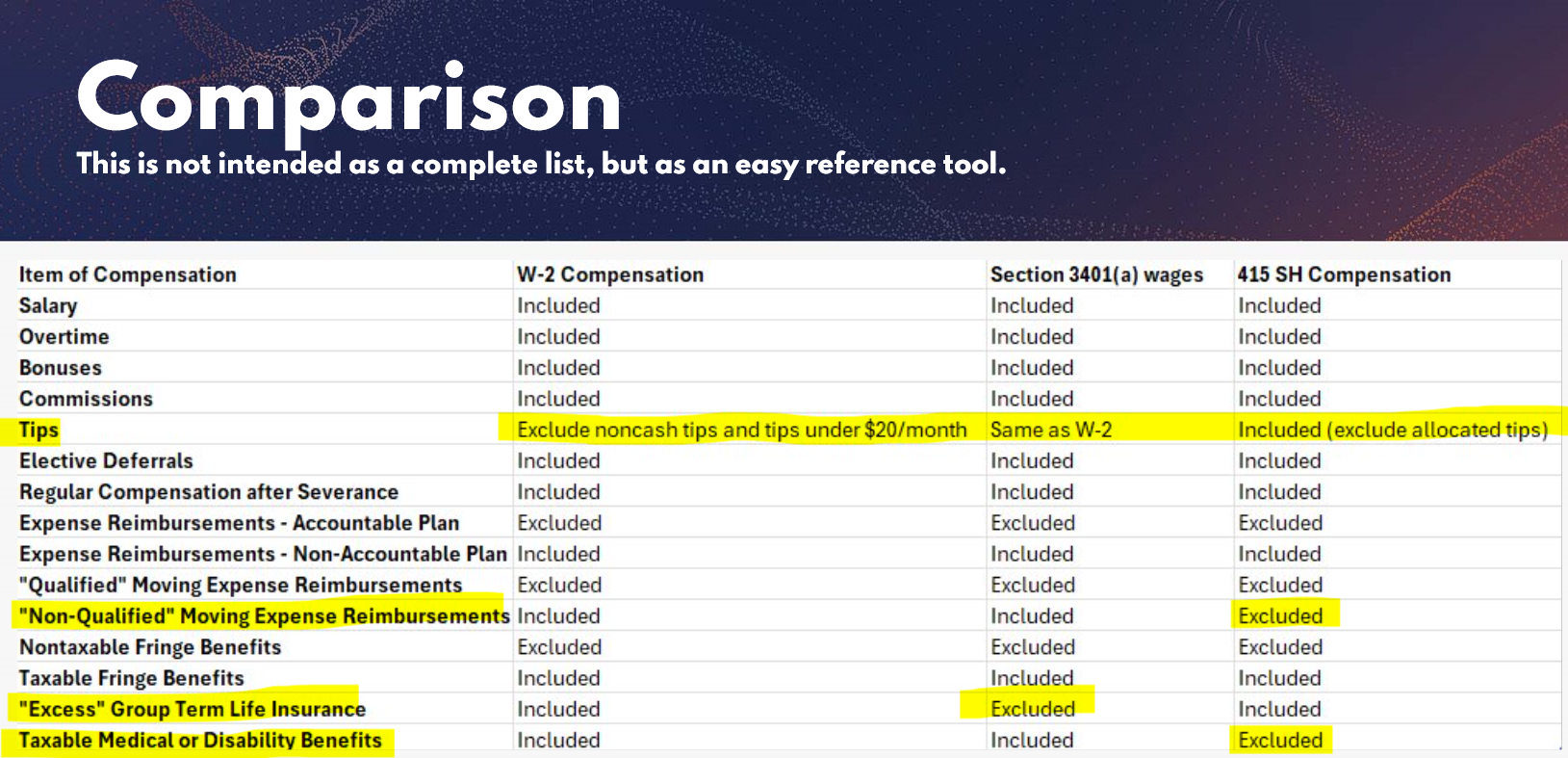
  1. W-2, Box 1 Wages: Most frequently used. Includes taxable wages reported on the employee’s W-2.
  2. Code §3401(a): Similar to W-2 wages but excludes certain items like the cost of group-term life insurance.
  3. 415 Safe Harbor Compensation: Broader definition that can include pre-tax deferrals and certain tips.

Be Careful with Compensation Exclusions

Your plan may start with a standard definition of compensation, like W-2 Box 1 wages—but it’s common for employers to want to exclude certain types of pay, such as:

  • Bonuses
  • Commissions
  • Overtime
  • Fringe benefits
  • Reimbursements and allowances

Here’s where things get tricky: applying exclusions that aren’t clearly written into your plan documents can create compliance issues. We’ve seen many employers consistently exclude things like bonuses or commissions from deferrals, assuming it’s okay because “that’s how it’s always been done” or “employees prefer it that way.” But unless the exclusions are formally documented in your adoption agreement or basic plan document, you’re likely out of compliance—even if your practice seems reasonable.

Bottom line: If your plan documents say all W-2 wages are included, then you must calculate deferrals based on all W-2 wages—unless specific exclusions are clearly authorized. When in doubt, clarify your documents or update them to match your actual practices.

Common Mistakes PriceKubecka Sees in Your 401(k) Audit

  • Improper Inclusion/Exclusion of Pay Codes: New pay types (like commission or PTO payouts) are added but not configured to calculate deferrals.
  • Post-severance pay: Forgetting that commissions paid after termination might still be deferrable.
  • Fringe benefits: Confusion about whether something like a gift card or car allowance counts as compensation.
  • Manual and Off-Cycle Checks: Manual payments and adjustments often bypass the deferral logic set up in payroll systems.
  • Post-Severance Pay Confusion: Pay issued after termination may still be eligible for deferrals, depending on how your documents define it.
  • System transitions: Changing payroll providers and failing to mirror deferral logic from the old system to the new.

Made a Mistake? Here’s How to Fix It.

The IRS offers three main correction programs, summarized in its Fix-It Guide:

  1. Self-Correction Program (SCP)
    Fix the error internally without notifying regulators. Best for small or recent mistakes.
  2. Voluntary Correction Program (VCP)
    Notify the IRS and correct the issue officially. Use this when the problem is widespread or involves large sums.
  3. Audit CAP (Correction Under Examination)
    If regulators find the error first, you’ll correct it under their supervision—usually the least desirable option.

What Can You Do to Prevent Errors?

Simplify Plan Documents: Avoid overly complex definitions. Choose a compensation definition that matches your payroll structure and employee demographics.

Clean Up Earning Codes: Review and eliminate outdated or unnecessary earning codes to prevent confusion and reduce audit risk.

Provide Staff Training: Train payroll teams to read and interpret plan documents, especially before changes in systems or processes.

Spot Check Regularly: Perform internal reviews annually or semi-annually, especially if you use lots of earning codes or frequently issue manual checks.

Use Payroll System Changes as an Opportunity: When switching providers, review your plan documents and align them with current payroll practices. This is a great time to clean house.

Who Can Help?

Navigating compensation definitions and correcting errors in your 401(k) plan can feel overwhelming—but you’re not alone. The right partners can make all the difference.

Payroll Providers can:

  • Ensure your earning codes are mapped correctly to reflect eligible compensation.
  • Help configure deferral rules across regular, off-cycle, and manual checks.
  • Support with system setup during provider transitions to prevent deferral calculation errors.

Recordkeepers and TPAs (Third-Party Administrators) can:

  • Interpret plan documents and clarify what is and isn’t included as eligible compensation.
  • Help draft amendments when your practices don’t align with your documents.
  • Guide you through IRS correction programs like SCP or VCP when needed.

💡 Pro Tip: TPAs are especially valuable when simplifying overly complex definitions or aligning your plan with how your company actually pays people.

    While they often bring the bad news, auditors are your first line of defense in catching issues before regulators do. A good auditor like PriceKubecka will:

    • Perform full-population testing of payroll data (not just sample testing).
    • Help identify patterns of compensation errors (e.g., missed bonuses, severance pay issues).
    • Offer practical advice to prevent repeat errors in future years.

    💡 Pro Tip: Don’t view the audit as just a compliance requirement—it’s a key opportunity to strengthen your controls.

    When you’re in a legal gray area or need to evaluate your compliance posture, ERISA counsel can:

    • Review your plan documents in-depth to determine what’s actually allowed.
    • Help interpret contradictory language between your adoption agreement and basic plan document.
    • Prepare formal responses to regulators or assist with voluntary correction filings.

    Get Ahead of Small 401(k) Compensation Issues Before They Become a Big Problem

    Compensation mistakes aren’t just a headache to address—they can also become costly. But with the right tools and habits, you can catch them early or avoid them entirely. And if you’ve inherited a mess, don’t panic—partner with your auditor, provider, and legal team to clean it up and put strong controls in place moving forward.

    Need help navigating a compensation issue in your 401(k)? We’ve audited hundreds of 401(k) plans and helped many companies identify, correct, and prevent these exact problems. From full population testing to practical guidance on corrections, we’re here to help. Let us know how we can support your team in keeping your 401(k) plan compliant, accurate, and working in your employees’ best interests.


    Does a Fiscal-Year 401(k) Plan Still Need an Audit?

    Potentially, yes.

    Operating on a fiscal year does not eliminate or change the basic requirement for an independent employee benefit plan audit. Whether a defined contribution plan requires an audit generally depends on its Form 5500 filing status and the applicable participant-count rules—not whether its plan year ends December 31.

    For defined contribution plans, the relevant participant count now focuses on participants and beneficiaries who have account balances at the beginning of the plan year, rather than everyone merely eligible to participate.

    So an off-cycle plan sponsor should answer two separate questions:

    Do we have an audit requirement?

    And, if so:

    When must that audit be completed so our Form 5500 can be filed on time?

    Those are related questions, but they aren’t the same question.

    When Should a Fiscal-Year 401(k) Audit Start?

    The Form 5500 deadline should be the end of your audit timeline—not the beginning of it. The safest approach is to work backward from your actual filing deadline and establish the audit schedule well in advance.

    If an independent audit is required, the auditor’s report generally accompanies the Form 5500 filing. That means the audit needs to be substantially complete before your filing deadline arrives.

    There isn’t one audit-start date that works for every plan. The amount of time needed depends on factors such as plan size, the availability of records, the complexity of the plan and whether testing identifies issues requiring follow-up.

    A practical timeline should allow time for:

    Data collection: Your team may need to gather census information, payroll data, contribution records, recordkeeper reports, participant files and plan documents.

    Audit testing: Your auditor will perform required procedures and may select participants or transactions for additional documentation.

    Follow-up questions: Missing information and discrepancies often require responses from HR, payroll, the recordkeeper, TPA or other providers.

    Resolving exceptions: Eligibility errors, contribution discrepancies, participant loans, distributions, compensation issues and other findings can require additional investigation.

    Final review and issuance: The audit team still needs time to complete its review and issue the auditor’s report before the Form 5500 is finalized.

    Example: A 401(k) Plan With a March 31 Year-End

    Suppose your plan year ends March 31.

    Your normal Form 5500 deadline is generally October 31.

    With a timely Form 5558 extension, the deadline can generally be extended to January 15.

    That does not mean January should become your target date for beginning the audit.

    Instead, the plan sponsor and auditor should establish a timeline that leaves enough time before the applicable deadline to obtain records, complete testing and address any unexpected issues.

    In other words:

    March 31 plan year-end → October 31 normal deadline → January 15 extended deadline

    Your audit calendar should be built backward from whichever filing deadline applies.

    Example: A 401(k) Plan With a June 30 Year-End

    A June 30 plan operates on a very different schedule.

    Its Form 5500 would generally be due January 31 of the following year.

    With a timely Form 5558 extension, the deadline would generally move to April 15.

    For that employer, traditional summer 401(k) “audit season” may be largely irrelevant. Its audit preparation and testing may instead take place during the fall and winter.

    That is why a plan with a non-calendar-year end should work with an auditor that maintains employee benefit plan audit capabilities throughout the year.

    What Can Delay an Off-Cycle 401(k) Audit?

    Having a different deadline doesn’t protect a plan from the same issues that slow down calendar-year audits.

    Some common audit roadblocks include:

    • Missing or inaccurate census information
    • Eligibility and plan entry-date errors
    • Incorrect employer contribution or match calculations
    • Incorrect application of the plan’s compensation definition
    • Late participant contributions
    • Participant loan problems
    • Vesting or forfeiture discrepancies
    • Distribution documentation issues
    • Differences between payroll and recordkeeper data
    • Delays obtaining information from outside service providers

    One of the advantages of starting early is having time to resolve those issues before they become filing-deadline problems.

    What If Your Fiscal-Year Form 5500 Deadline Falls on a Weekend or Holiday?

    There is an important exception to the dates in the chart.

    If a Form 5500 filing deadline falls on a Saturday, Sunday or federal holiday, the filing can generally be made on the next day that is not a Saturday, Sunday or federal holiday. U.S. Department of Labor

    That means sponsors should verify the precise deadline for the applicable filing year rather than relying solely on a recurring calendar.

    The month-by-month chart is best used as a planning guide.

    What About Short Plan Years?

    A short plan year can occur when, for example, a plan changes its plan-year end or terminates and completes the distribution of plan assets.

    The general Form 5500 timing rule still applies: the filing is generally due by the last day of the seventh calendar month after the short plan year ends, subject to an authorized extension. U.S. Department of Labor

    Short plan years can introduce additional reporting and audit considerations, so sponsors should coordinate the filing timeline with their TPA, auditor and other advisors rather than assuming the normal annual schedule applies.

    Don’t Build Your Audit Around October 15 If October 15 Isn’t Your Deadline

    October 15 gets enormous attention in the 401(k) industry because it is the extended Form 5500 deadline for many calendar-year plans.

    But it’s only one deadline.

    For a non-calendar-year plan, your filing date could fall in January, April, June, November—or virtually any other month.

    Your audit calendar should therefore begin with three questions:

    When does our 401(k) plan year end?

    When is our Form 5500 due?

    When does the audit need to begin to comfortably meet that deadline?

    Once those dates are established, your organization can build a recurring compliance calendar around its own plan rather than someone else’s audit season.

    Looking for a 401(k) Auditor for a Fiscal-Year Plan?

    PriceKubecka performs employee benefit plan audits throughout the year for both calendar-year and non-calendar-year 401(k) plans.

    Our employee benefit plan specialists perform more than 400 EBP audits annually, including 401(k), 403(b) and ESOP audits. Because employee benefit plan auditing is a significant part of our audit practice, we can work with plan sponsors whose audit and Form 5500 deadlines fall throughout the year.

    Whether your plan ends March 31, June 30, September 30 or another date, your audit should be built around your plan year and your deadline.

    [Talk to a 401(k) Auditor]

    Example: A 401(k) Plan With a March 31 Year-End

    Suppose your plan year ends March 31. Your normal Form 5500 deadline is generally October 31.

    With a timely Form 5558 extension, the deadline can generally be extended to January 15.

    That does not mean January should become your target date for beginning the audit.

    Instead, the plan sponsor and auditor should establish a timeline that leaves enough time before the applicable deadline to obtain records, complete testing and address any unexpected issues.

    In other words:

    March 31 plan year-end → October 31 normal deadline → January 15 extended deadline

    Example: A 401(k) Plan With a June 30 Year-End

    A June 30 plan operates on a very different schedule.

    This plan’s Form 5500 would generally be due January 31 of the following year. With a timely Form 5558 extension, the deadline would generally move to April 15.

    For that employer, traditional summer 401(k) “audit season” may be largely irrelevant. Its audit prep and testing may instead take place during the fall and winter.

    That’s why a plan with a non-calendar-year end should work with an auditor that maintains EBP audit capabilities throughout the year.

    In other words:

    June 30 plan year-end → January 31 normal deadline → April 15 extended deadline

    What Can Delay an Off-Cycle 401(k) Audit?

    Having a different deadline doesn’t protect a plan from the same issues that slow down calendar-year audits. Some common audit roadblocks include:

    • Missing or inaccurate census information
    • Eligibility and plan entry-date errors
    • Incorrect employer contribution or match calculations
    • Incorrect application of the plan’s compensation definition
    • Late participant contributions
    • Participant loan problems
    • Vesting or forfeiture discrepancies
    • Distribution documentation issues
    • Differences between payroll and recordkeeper data
    • Delays obtaining information from outside service providers

    One of the advantages of starting early is having time to resolve those issues before they become filing-deadline problems.

    What If Your Fiscal-Year Form 5500 Deadline Falls on a Weekend or Holiday?

    There is an important exception to the dates in the chart. If a Form 5500 filing deadline falls on a Saturday, Sunday or federal holiday, the filing can generally be made on the next day that is not a Saturday, Sunday, or federal holiday. 

    That means sponsors should verify the precise deadline for the applicable filing year rather than relying solely on a recurring calendar. The month-by-month chart is best used as a planning guide.

    What About Short Plan Years?

    A short plan year can occur when, for example, a plan changes its plan-year end or terminates and completes the distribution of plan assets.

    In this case, the general Form 5500 timing rule still applies: the filing is generally due by the last day of the seventh calendar month after the short plan year ends, subject to an authorized extension. 

    Short plan years can introduce additional reporting and audit considerations, so sponsors should coordinate the filing timeline with their TPA, auditor, and other advisors rather than assuming the normal annual schedule applies.

    Don’t Build Your Audit Around October 15 if it isn’t Your Deadline

    October 15 gets enormous attention in the 401(k) industry because it is the extended Form 5500 deadline for many calendar-year plans. But it’s only one deadline.

    For a non-calendar-year plan, your filing date could fall in January, April, June, November—or virtually any other month. Your audit calendar should therefore begin with three questions:

    1. When does our 401(k) plan year end?
    2. When is our Form 5500 due?
    3. When does the audit need to begin to comfortably meet that deadline?

    Once those dates are established, your organization can build a recurring compliance calendar around its own plan rather than someone else’s audit season.

    Looking for a 401(k) Auditor for a Fiscal-Year Plan?

    PriceKubecka performs employee benefit plan audits throughout the year for both calendar-year and non-calendar-year 401(k) plans.

    Our EBP specialists perform more than 400 audits annually, including 401(k), 403(b) and ESOP audits. Because employee benefit plan auditing is a significant part of our audit practice, we can work with plan sponsors whose audit and Form 5500 deadlines fall throughout the year.

    Whether your plan ends March 31, June 30, September 30, or another date, your audit should be built around your plan year and your deadline.

    [Talk to a 401(k) Auditor]

    Related Articles